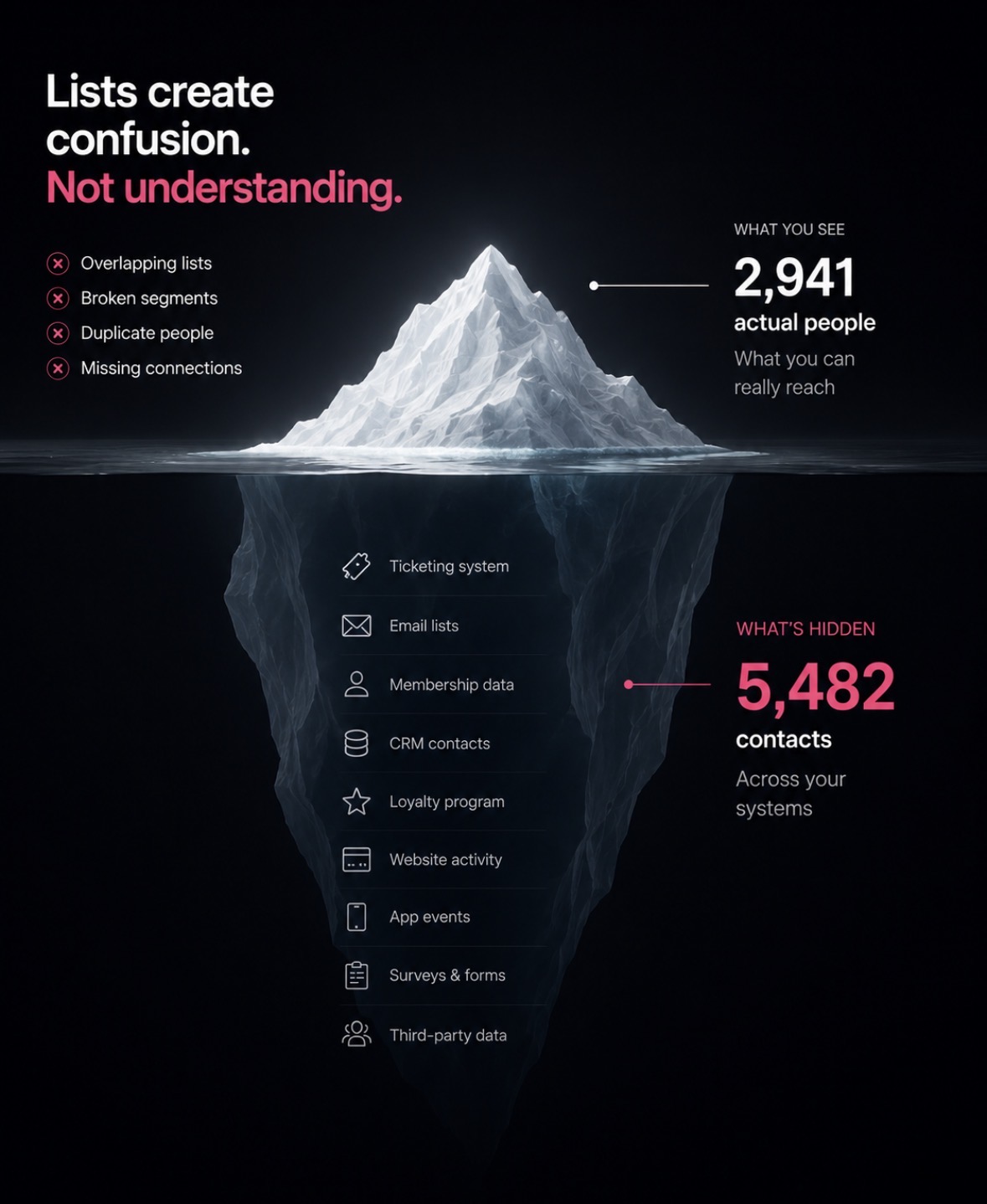

Most newsletter platforms and surprisingly enough - even modern marketing platforms were built around one core idea:
Lists.
At first, that made sense.
You imported contacts, created campaigns and organized communication through separate mailing lists.
But over time, something happens.
The same audience becomes scattered across:
- ticketing systems
- CRM tools
- newsletter lists
- memberships
- campaigns
- consent structures
Suddenly, the same person exists multiple times - disconnected from their own history.
And that fragmentation quietly compounds over time.
Most organizations don’t actually have an audience acquisition problem.
They have an audience continuity problem.
Because when audience identity becomes fragmented:
- retention weakens
- reachable audience declines
- historical behavior gets disconnected
- and organizations gradually lose visibility into the audience they already built
The result?
Organizations keep spending money acquiring audiences they often already had.
Traditional platforms still optimize around:
- list growth
- profile volume
- campaign workflows
But more profiles do not necessarily create more audience value.
In many cases, fragmented audience identity creates:
- more noise
- weaker continuity
- lower retention
- and less understanding of the audience over time
At Lily, we asked a different question:
> What if communication platforms were built around audience identity instead of lists?
That led us to build Lily around one unified audience layer.
Instead of duplicated contacts across disconnected structures, Lily works through:
- connected audience profiles
- communication channels
- audience continuity
- legal communication foundations
- accumulated audience intelligence
One connected profile across:
- ticket purchases
- engagement
- loyalty
- behavioral history
- communication
- marketing consents
All connected over time.
Traditional newsletter systems organize communication through lists.
Lily organizes communication through channels.
That allows organizations to communicate across:
- marketing permissions
- memberships
- operational updates
- event communication
- important information
…without duplicating the same audience across multiple disconnected structures.
The result:
- cleaner consent architecture
- stronger audience continuity
- lower fragmentation
- and significantly more reachable audience value

Because audience value should compound over time.
Not reset every season.
And when audience identity becomes connected again, organizations often discover they already own far more audience value than they realized.
We now consistently see organizations increase reachable marketing consents by 25–40%
simply by replacing old list-based platforms with Lily.
Same audience.
Better structure.
More reachable audience value.
Traditional newsletter platforms helped organizations send campaigns.
But most platforms still only let organizations segment and communicate across smaller fragmented parts of their total audience.
Lily was built differently.
Because everything is connected over time, organizations can build audience segments across their full audience relationship:
Not just isolated lists.
The result is not just better segmentation.
It’s audience understanding that compounds over time and segments that increasingly turn into retention, loyalty and ticket sales.
